What is included in commercial hood and canopy cleaning?
Understand what a normal service should cover, what may be extra, and what to confirm before booking.
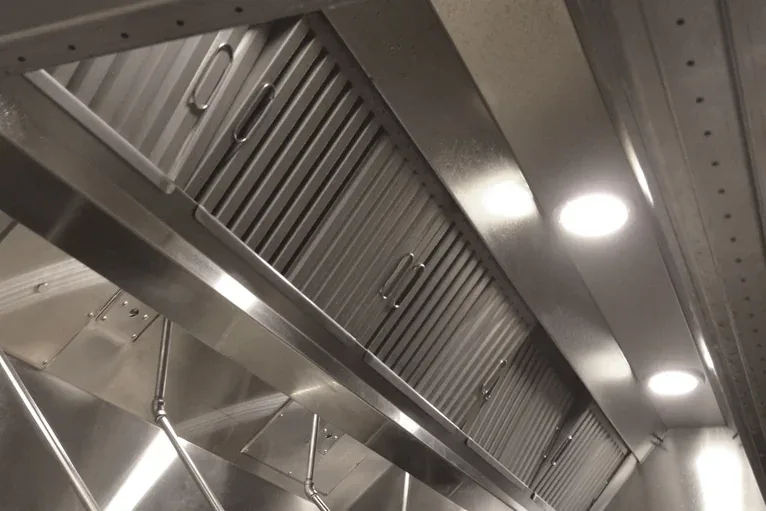
Commercial kitchen hood filters are the first line of defence against grease entering the exhaust system. They collect grease from cooking vapours before it reaches the hood plenum, ductwork and fan. Filters need regular cleaning, but cleaning is not the same as repair. A filter that is bent, corroded, cracked or no longer fits properly may need replacement even after it has been washed. Knowing the difference helps managers decide what to do next.
Hood filters sit in the hood or canopy over cooking equipment. They intercept grease-laden air and help keep grease out of the exhaust system. They also affect airflow and the fire load in the hood. A clean, correctly fitted filter does its job better than a loaded or damaged one.
Filters do not replace the need to clean the hood, plenum, ductwork and fan. Grease that passes the filters or collects on surfaces still needs to be removed on a suitable schedule.
Commercial hoods commonly use baffle-type grease filters, which use overlapping metal baffles to change the direction of the air and capture grease. Some systems use mesh filters or other designs. The right type depends on the hood, the cooking equipment and the manufacturer's instructions.
Mesh filters are not automatically suitable for every grease-producing application, and a filter that fits one hood may not be correct for another. Use the hood manufacturer's specification and the applicable requirements for your system.
Grease accumulation is normal. Filters load up during cooking and need cleaning at a frequency that suits the kitchen. Physical damage is different:
Cleaning removes grease. It does not straighten a bent frame, repair a crack or restore corroded metal. A cleaned damaged filter is still damaged.
Managers can check filters visually from floor level without climbing or reaching into the hood:
If a filter is hot, damaged or difficult to reach, do not handle it. Follow the manufacturer's instructions and your staff training. Some filters can be washed in a dishwasher or soak sink; others require a different method. The manual for the hood and filters should be the reference.
Cleaning removes the grease that has collected on the filter. It does not change the filter's shape, strength or fit. A bent baffle can create gaps. Corrosion can thin the metal. A damaged frame may not hold the filter securely. A filter that no longer fits can allow grease to bypass the filter and enter the hood or duct.
In that situation, more cleaning is not the answer; the filter needs to be assessed and, if necessary, replaced with a suitable part.
Damaged, missing or poorly fitting filters can contribute to grease carryover into the hood and duct, reduced airflow, uneven exhaust, more frequent cleaning needs and a higher fire load. They can also make the hood harder to keep clean. The exact effect depends on the system, the cooking operation and the damage.
A filter that is merely dirty is a cleaning issue. A filter that is physically damaged or unsuitable is a replacement issue.
Filter cleaning frequency depends on cooking volume, cooking style, filter type and the manufacturer's instructions. Some kitchens need daily cleaning; others can go longer. Local requirements and your authority having jurisdiction may also apply. There is no single interval that fits every kitchen.
The hood manufacturer's manual and the service provider's assessment are better references than a generic calendar. If the kitchen changes its menu, volume or equipment, review the filter routine.
Manufacturer guidance for commercial hoods commonly calls for filters to be kept clean and in place, and for filter components to be inspected for physical defects. See CaptiveAire's hood filtration guide for an example; the instructions for your own hood take precedence.
Keep filters clean and correctly fitted, train staff on the routine the manufacturer specifies, and note any damage or poor fit. Do not operate the hood with filters missing or incorrectly installed unless the manufacturer's instructions say otherwise. Keep a record of cleaning and replacement.
When a professional cleaning is due, ask the provider to check filter condition and flag anything that needs replacement. Do not climb onto the hood or reach into the exhaust to retrieve a filter; use the safe access method for your system.
Arrange an inspection or replacement if a filter is bent, cracked, corroded, missing parts, the wrong size or type, or no longer seats properly. Replacement should match the hood manufacturer's specification and the filter's intended application. A generic filter that happens to fit the opening may not provide the same performance.
Grease Shields cleans accessible filters as part of hood and canopy cleaning and will point out damaged or poorly fitting filters. Replacement may be arranged separately; ask about the correct part for your system.
Clean filters help, but they do not make the entire exhaust system clean. Grease collects in the hood plenum, ductwork and fan, and those areas need cleaning on a schedule that suits the kitchen. Access panels, fan condition and duct layout affect what can be reached. A filter replacement is not a substitute for hood and duct cleaning.
For the wider scope, read what is included in commercial hood and canopy cleaning and why exhaust access panels matter.
Cleaning removes grease but does not repair physical damage. If the filter is bent, cracked, corroded or no longer fits, it should be assessed for replacement.
It depends on cooking volume, filter type and the manufacturer's instructions. Some kitchens clean filters daily; others less often. Follow the guidance for your system and local requirements.
Some systems use mesh filters, but suitability depends on the hood, cooking equipment and manufacturer's specification. Do not assume a mesh filter is a direct replacement for a baffle filter.
If your restaurant is in St. John's or elsewhere on the Island of Newfoundland and your hood filters are due for cleaning or you have noticed damage, Grease Shields can include accessible filters in a hood and canopy cleaning visit and flag condition issues. See the hood and canopy cleaning service or request a quote. For the between-visit routine, read our hood maintenance checklist.